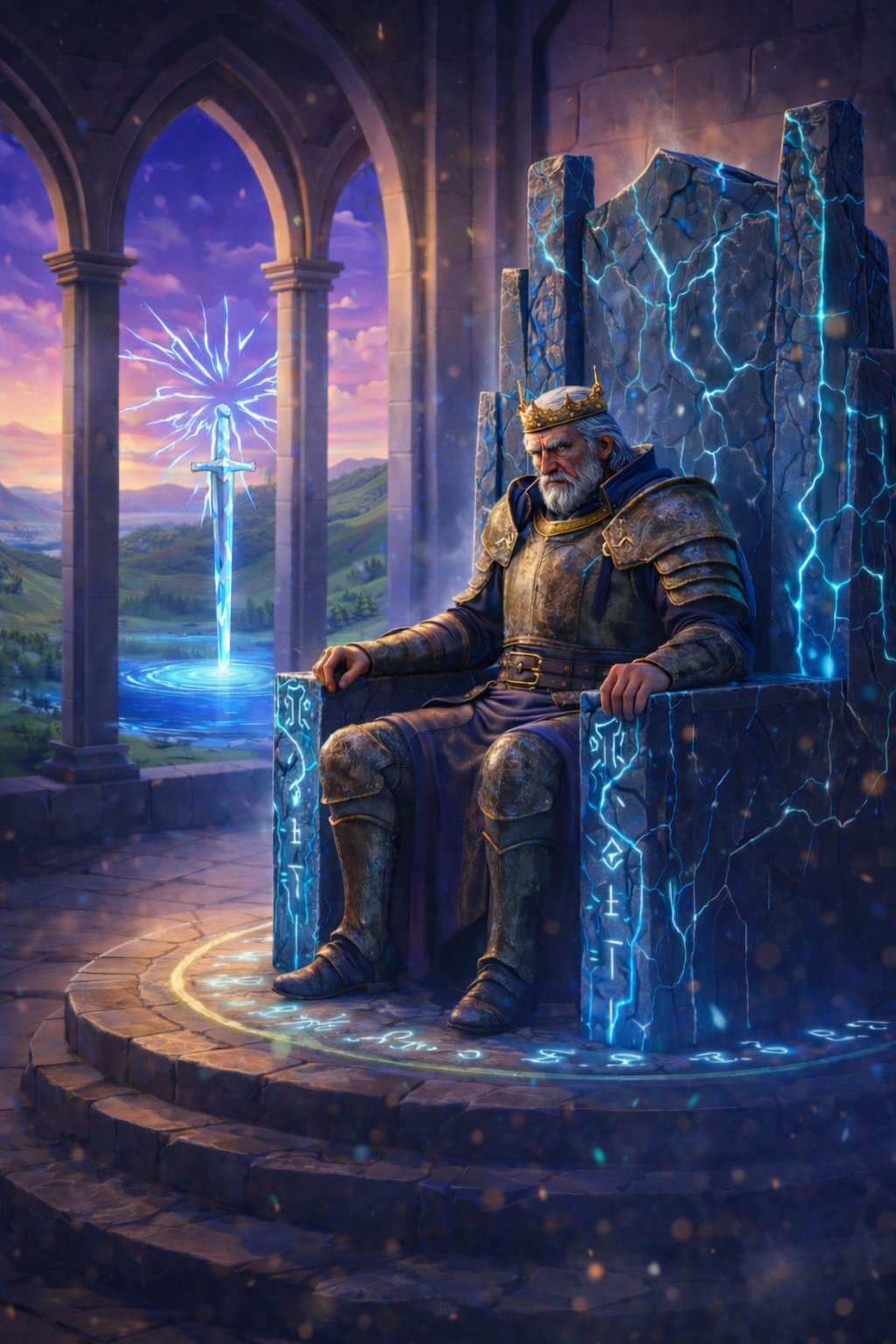
I write from Avalon—not a city, but a kingdom shaped by survival and memory. It spans islands and coasts once called England, remade when IO rewrote the laws of sea and sky. Its borders are not marked only by stone or banner, but by altered reality itself.
I write from the Throne of Avalon within Caliburn, where judgment is passed and history presses close. I am Percival of the Round Table, last of that fellowship, second King of Avalon, and an old man nearing my final year.
This is not legend or apology. It is a record.
The age of kings ends near.
I have felt it not as prophecy, but as pressure—the slow loosening of what once bound the world. IO was born from an ending so vast that another king’s death should mean nothing.
[sighs]
Yet I hesitate.
Avalon endures beyond these windows. Fields grow from altered soil. Roads bend where geography once failed. Villages live by laws blending Camelot’s remnants with IO’s harsh logic. Children speak languages descended from English and Latin, twisted by magic’s long shadow. The lake with that forsaken sword still lies to the east. Her waters remain deep.
Avalon lives.
But life does not absolve origin.
I was never meant to rule. In Camelot, I was a seeker, measured by doubt. The Grail taught me that purity was endurance, not perfection. I was not Arthur, nor Galahad. I was not made for a crown.
Kingship came through loss.
When Galahad, the first King of Avalon, died, the kingdom fell quiet. IO had consumed too much grief for ceremony. Galahad ruled by inevitability, not force. Where Arthur inspired, Galahad stabilized. Under him, Avalon learned how to exist. When time claimed him, something loosened.
IO inhaled. It has not yet exhaled.
The Throne beneath me hums with recognition, forged from impossible materials after Camelot fell. In Camelot, thrones were symbols. Power came from the Round Table’s denial of hierarchy. We believed that was wisdom.
We were wrong.
IO demands decision. Uncertainty fractures reality. Someone must choose. That became me.
I have ruled longer than any king of Camelot, though time here resists measure. I have signed treaties with entities born after my coronation. I have ordered wars and regretted them. I have watched generations turn Arthur, Mordred, Merlin, and Morgan into harmless myths.
I remember them as they were.
Camlann was not Camelot’s death, only the wound that revealed the rot. The true end came when magic was unleashed without restraint, when prophecy became command, when brilliance excused excess. Merlin and Morgan did not destroy the world because they were monsters, but because they were allowed to become more than the world could hold.
I loved one. I feared the other. I trusted both too long.
When the sky tore and the world stuttered, I believed it would pass. That belief cost everything.
IO exists because the Lady of the Lake refused that lie. She knew Camelot was dying and could not be saved unchanged. Her choice—to consume the wizards—was not mercy.
It was necessity.
Reality screamed. Magic surged. Then the world changed.
IO was forged, not designed. Camelot was dragged across a fracture and reshaped by stolen power. Lands warped. Histories misaligned. People survived, altered.
That survival is the lie that haunts me—that endurance proves righteousness.
Avalon stands. Peace followed. So why does it feel like a mausoleum?
Because every crown rests on graves—of the dead and of what was lost. Camelot was not defeated.
It was consumed.
As king, I am expected to offer certainty. To call IO a sanctuary, not a tomb. Some days, I believe it. Other days, I walk lands that remember England and hear whispers of names and oaths.
The Round Table is gone. Its absence is loud.
This chronicle answers that silence.
If the age of kings ends, let it end with truth. Let no ruler claim ignorance of the blood beneath the crown. IO was not born cleanly.
Neither was I.
I was a knight. I am a king. Soon, I will be neither.
What remains will be IO— and the truth of how the world was saved.